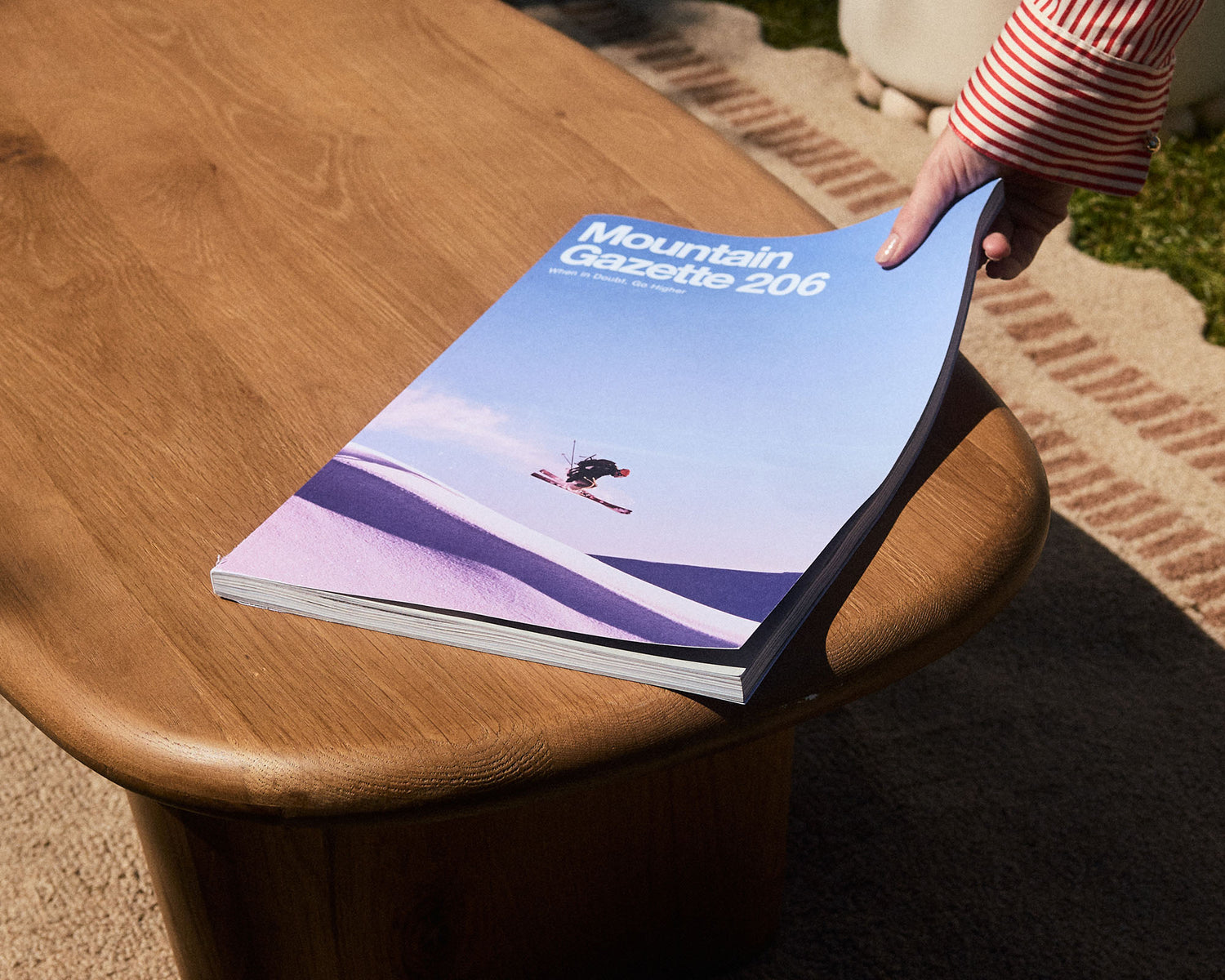


After a decade online, Field Mag founder Graham Hiemstra is betting there’s still something worth making on paper.
By Hannah Truby
For a publication born online, Field Mag has always felt a little more tactile than purely digital. In 2015, design nerds and outdoor enthusiasts Graham Hiemstra and Chris Stillitano launched what was then The Field from a one-bedroom apartment in Brooklyn, hoping to fill a specific gap in outdoor media: a publication for city-dwelling outdoor enthusiasts who cared as much about design and aesthetics as they did about getting outside. More than a decade later, the publication has begun a new chapter in print.
Now two issues in, the print magazine is a physical expression of the ethos that has defined the publication from the start—a convergence of outdoor gear, photography and design, with room for new perspectives and, of course, a deliberately expansive idea of what it means to be an outdoor person.

For Hiemstra (above), going to print was a natural extension of Field Mag’s roots in analog photography. “Promoting outdoor recreation is inherently physical,” he says. “So books, print magazines, these types of things, I think it’s always just been loosely in the DNA.”
The magazine, in its current miniature-book format, grew out of Field Mag’s 10th-anniversary brand refresh, which introduced a new wordmark, website, and visual identity. Having already produced several film photography zines, the leap to print felt less like a departure than a return to something that had always been part of the brand: a physical extension of the broader digital ecosystem it had built online.
We caught up with Hiemstra after the launch of issue 02 to talk about why he decided, in the middle of the digital-media crisis, that the future of his magazine should include print; what he’s learned about making a magazine the old-fashioned way; and where Field Mag goes from here.
Hannah Truby: You just had a launch party in Seattle for Field Mag’s second issue. How was that?
Graham Hiemstra: Oh, it was a ton of fun. I was really impressed with Seattle. I went to high school there, so I'm familiar, but I don't spend much time there anymore. The turnout was great. We had a couple hundred people come through. There was a line out the door to get in, and the party went pretty late. It was a really diverse crowd, with a lot of different ages. And we sold another 150 magazines or so, so that was good.
So far for issue 02, we've hosted celebrations in Paris, the Lofoten Islands in Norway, New York, and then Seattle. We're in the process of planning one for Tokyo, maybe early November. We're still figuring out the timing of that.
Wow! I didn’t know the mag had such an international reach, that’s awesome.
We've had a handful of folks reach out from Japan looking to help with distribution and just share their enthusiasm. We worked with one stockist last year, and then we're working with a few other larger Japanese outdoor retailers right now to get Field Mag stocked there. So that's exciting. I'm not sure if that many folks are English speaking and reading it or they're looking at the pictures. Either way, I love to read Japanese outdoor magazines myself, so I get it.
You spent a decade building an audience online. Why did you decide that its future should include print?
We published online for 10 years before introducing the print magazine in the form that it exists in today. Personally, I grew up reading snowboard and skateboard magazines—Transworld, Thrasher—and that was a huge part of my childhood and my development as someone who's interested in subcultures and the outdoors. I've also always loved analog mediums. I've been into film photography for 20 years now, and film photography has always been a core pillar of what we do. We had done three different film photo zines prior to introducing the print magazine, so we'd been doing print projects for about five years already.

The print magazine came out of our 10th anniversary brand refresh. We introduced a new wordmark and website and really just breathed new life into the business and the identity we'd been operating with for the past decade. The print magazine exists within a larger digital ecosystem where everything we do, from social media to video to the website to print to events, all feeds into and informs each other.
You’ve now made two print issues. What did you learn from putting Issue 01 into the world, and how did it change the way you approached Issue 02?
I learned how difficult it is to make a print magazine! As someone who has enjoyed print my whole life and worked in magazines and media for a couple decades now, I was amazed how little digital media prepared me for making a print magazine in terms of timelines and how much production goes into it.
But from maybe a more interesting perspective, the feedback we received from issue 01 was how much people enjoyed the variation in the storytelling and the uniqueness of our articles and content. So for Issue 2, we really tried to find unexpected stories and other ways of continuing to explore different definitions of adventure. I think we achieved that pretty well with issue 02.
You said that when you started the publication, you wanted to push back against the outdoor media’s narrow idea of what an “outdoor person” looked like. What did you feel the media was missing about people who lived in cities, and how have you tried to reach that audience through Field Mag?
I think a lot of people in the core outdoor space for a long time have viewed city people as kooks or weekend warriors who are somehow less legitimate in their love for nature. I grew up spending 200 days a year snowboarding, going to Mount Hood in the summer, living in New Zealand, hiking, camping, basically as outdoors as you can get. And then I moved to New York, focused on a career, and became interested in fashion and design and all these other things. To me, that more adult version of my life felt less legit in the eyes of the outdoor media because I wasn't skiing 100 days a year or whatever. I thought it felt silly that we had to define someone's love and interest in the outdoors by how often they participate in it. The outdoor media at the time, in the early 2010s, was so heavily focused on who could be more core that it felt too intense for me
At the same time, I saw the snowboard industry go from who could do the most spins or biggest tricks to being defined by who was the most interesting and had the most style. I saw that happening in the outdoors as well, where people were defining themselves less by “I do one activity” and more as “I'm an outdoor enthusiast who's interested in trying all sorts of different things.” That includes making art, shooting photography or being interested in style. As we see now over a decade later, style and personal expression through clothing, apparel, and gear is so ingrained in the culture. I wanted to be at the forefront of that movement. Our audience understands that being interested in style is not silly or detracts in any way from your ability to succeed in big pursuits in the outdoors.
How does that philosophy shape the way you reach your audience, both editorially and through marketing?
I grew up in subcultures where if you say you're good at something, it means you're not. It's more about the unwritten rules, social cues and style that tell people whether you're good at something or not. Initially with Field Mag, I put a lot of effort into having our contributors be professional athletes and legit adventurers. For the first six or seven years, we never stated anywhere that we were experts or that we were in some way an authority. We really wanted the “show, don't tell” perspective to lead the way. And all of our growth through the years has been purely organic. We've never really advertised.
I think our unique style of content and the type of articles we're publishing—interviews with designers and athletes, film photography, photo essays, and the products we choose to cover—is always very aesthetically driven. When people are introduced to Field Mag, they know it's for them. And if they don't feel that way, then that's fine too.

Mountain Gazette has always been pretty staunchly against gear reviews—they’re just not part of our brand. Something I really respect about Field Mag, though, is your ability to bring together gear, travel, photography, and longer, more meaningful features. From the editorial side, how do you think about bringing those different kinds of stories together under one editorial identity?
It's interesting you mentioned gear not being part of the MG identity because we've felt similarly for a long time. There are so many publications that strictly do product reviews, and they do them very well. That said, we feel that we have a unique lens and a certain taste that's lacking in other outdoor publications, specifically ones doing product reviews. While we’re certainly focused on what is the best-performing product, we also know that if a product works great but looks like shit, I don't really have an interest in using it. Unless it's for life-or-death situations, and we're not reviewing alpine mountaineering equipment.
No matter what we do—from photography to product reviews to who we interview or feature, or even locations we feature guides to—all of that is decided through a criteria of aesthetics and design. So while we cover a large number of topics in a large number of ways, there's a through line of good design that ties it all together. It's all presented through this elevated lens of a more curated outdoor experience.

Looking through Issue 02, is there one story, photograph, or piece that feels especially representative of what you’re trying to do with Field Mag right now?
I’d say the profile on Gnuhr, which is an ultralight apparel and gear studio out of Portland. I met the principal designer, Nur Abbas, at our issue 01 launch party. I was already a fan of his brand, but getting to know him was really interesting. His brand is doing some super innovative stuff. The feature also explores how their studio designs for other brands, like Goldwin and even Uniqlo. That's not really a mode of operation in the outdoor industry, and Gnuhr is one that I've been really fascinated by.
Our designers had a lot of fun with the profile, and I think visually it's super striking. It really is kind of a hero feature in the magazine, and it's one of my favorite covers.

In 2024, you said you hoped to be “releasing a proper, full-size editorial magazine” by the following year. Now that you’ve reached that milestone, what do the next chapters of Field Mag look like?
This year our studio, which operates behind the scenes, has had some great opportunities to work with brands. It’s been a really interesting, natural evolution of doing more in-person events and flexing our studio agency muscles to produce for larger brands. People are coming to us because we have a unique point of view and a deep roster of talented contributors, and that’s been really rewarding.
I’ll certainly continue making the print magazine and online editorial content, that will always be our bread and butter and the backbone of Field Mag. But the studio work continues to open new doors and create more interesting opportunities to work with our contributors and put our perspective out there through different channels.
Is there anything else you want to touch on?
I think the last thing I’d add is that Field Mag is very much a sum of many parts and very community driven. We had over 40-something contributors for issue 02, and even though it's just a handful of us pulling the strings behind the scenes, it’s the contributors and the community—the people reading, buying, supporting, coming to the events and having a good time—that are the real backbone of Field Mag.